Besides my usual urban analysis interests, I also have a deep and abiding love of history. In fact, my undergraduate degree is in History, so reading, thinking and writing about historical events is something that I very much enjoy doing.
During some downtime last weekend I found myself perusing the Programming Historian website. This is an excellent site if you’re interested in applying data science techniques to historical research. One of the posts that caught my eye was one that used the R package “syuzhet” (a Russian word that refers to the ‘device’ or technique of a narrative) to conduct a sentiment analysis of a Spanish novel from the 1880s.
I decided to use the syuzhet package on a much shorter piece of text – the declaration of the Provisional Government of the Irish Republic, proclaimed by Padraig Pearse at the General Post Office on Easter Monday 1916. Known as the Easter Rising, fighting between Irish revolutionaries and British soldiers lasted about a week, ending in the collapse of the rebellion and the execution of many of the Rising’s leaders.
The Irish declaration is a call to arms and a striking pronouncement of Irish freedom. One of the more striking passages comes near the end of the document:
“The Irish Republic is entitled to, and hereby claims, the allegiance of every Irishman and Irishwoman. The Republic guarantees religious and civil liberty, equal rights and equal opportunities to all its citizens, and declares its resolve to pursue the happiness and prosperity of the whole nation and of all its parts, cherishing all of the children of the nation equally, and oblivious of the differences carefully fostered by an alien Government, which have divided a minority from the majority in the past.”
It’s stirring, rousing prose, but ultimately was not enough to push the rebellion to success.
Let’s see how the syuzhet package interprets the sentiment of this document. There are 4 different lexicons available with the syuzhet package – Bing, Afinn, Standord, and NRC Word-Emotion Association Lexicon, which is what I’ll be using for these documents. You can read more about different lexicons here. The NRC lexicon includes positive and negative sentiment values and eight emotional categories.
To get the sentiment scores for the Irish Declaration, I use the syuzhet package to break the text into “tokens”, or the individual words that make up the document, and then use a function to get a summary of the values associated with six emotions and two sentiments. We can see that, on average, the Irish Declaration contains more positive language than negative and more joyous language than sad. What’s interesting is that the Declaration contains almost as much fearful language as joyous but also contains a fair amount of trusting language.

The bar plot below shows the overall percentage of each emotion in the declaration. Trust is the highest percentage emotion in the text, as if the signatories of the declaration are working hard to convince their fellow Irish of the worthiness of their cause. Joy and fear are the next two emotions in the text. I see these as two opposing emotions. One the one hand, joy signifies the possibility of a future as a free and independent nation. One of the other, there’s the fear both of failure but also of remaining under the boot heel of the British Empire.

It’s clear that the Irish declaration is designed to elicit great emotion from the reader. Perhaps that was the writers’ larger goal – if Irish men and women joined the Easter Rising because of the declaration, great. But if the revolution should fail, the document would live on as an inspiration to future Irish revolutionaries.
Examining the Irish Declaration’s word cloud can give us a better understanding of how the model groups words into the emotional categories show in the bar chart. Below we see some of the individual words with the strongest sentiment scores for Fear (red), Anticipation (green), Joy (yellow), and Trust (blue). The font size of each word corresponds to the frequency with which it appears in the document. It’s interesting that “government”, with one of the largest font sizes, appears in the Fear category, equating government with oppressive and “alien” British rule. On the opposite emotional spectrum, Trust contains several words the writers of the Declaration use to bind Irish people together and claim “unfettered control of Irish destinies”. The writers assert their right to “national freedom and sovereignty” and evoke the new nation’s strength in attempting to throw off British rule.

Similar Emotional Distribution in Other Declarations of Independence?
I now want to explore the emotional range of some other declarations of independence from formerly colonized countries and one revolutionary declaration from a country that overthrew their monarchy. Here is the list of countries and their declarations I’m going to analyze.
| Country | Colony Of: | Year Declaration Published |
| United States | Britain | 1776 |
| French Revolution | N/a (Monarchy) | 1789 |
| Mexico | Spain | 1821 |
| India | Britain | 1930 |
| Congo | Belgium | 1960 |
United States Declaration of Independence
This will be most familiar to a wide audience and is often cited as the inspiration for many democratic movements that have occurred throughout history. It contains the famous line of identifying “life, liberty, and the pursuit of happiness” as the inalienable rights of all men (are we sure about that?), while also declaring all men equal (are we sure about this, too?). The writers of the Declaration of Independence bend themselves over backwards justifying their push for freedom, laying out a litany of “usurpations” and tyrannies perpetrated against the colonies by King George III. They want to make sure that the world knows they are not throwing off the yoke of this tyrannical government on a whim – no, they lay out numerous reasons why they are breaking from Britain and altering their “systems of government”.
The US Declaration begins with lofty ideals and insists on the equality of all men, the rest of the document becomes a list of grievances and complaints. There’s no wider call for colonists to join the cause for freedom, just a submission of facts to a “candid world” outlining abuses of the British monarchy. After reading through the document, I’m predicting that the 4 most common emotions the syuzhet model produces will be anger, fear, disgust, and anticipation.
Interestingly, the US Declaration contains more positive sentiment than negative, as well as a high Trust emotion average. The next highest emotional averages are Fear and Anticipation.

We see below that over a quarter of the words used in the US Declaration of Independence fall into the Trust emotional category, followed by Fear, Anticipation, and Sadness.
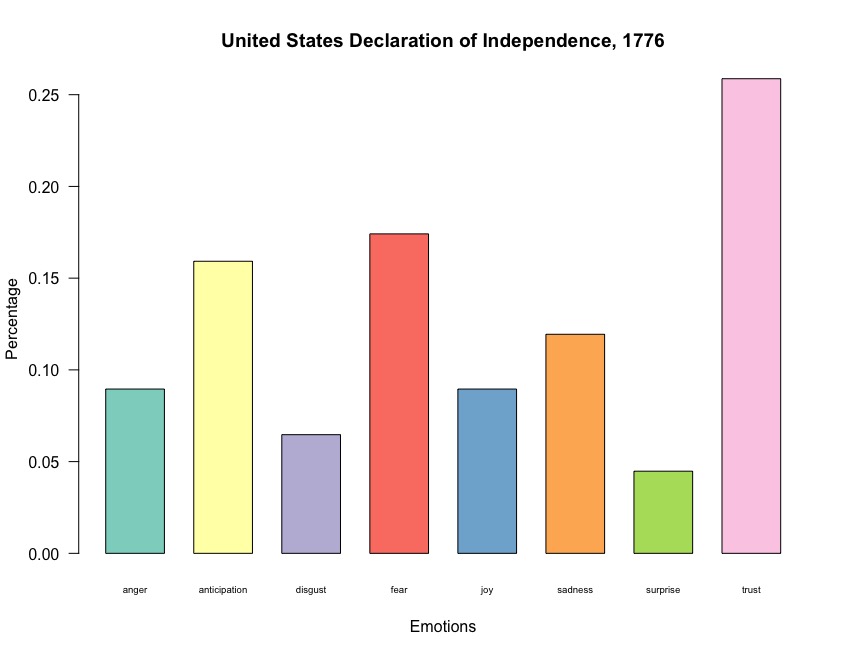
Like the Irish Declaration, Trust is the overwhelming emotion throughout the US document. Fear and Anticipation are also present throughout the text, as is Sadness, which is not present in the Irish declaration. The text categorized as Sadness links to phrases lamenting the refusal of the British monarchy to “assent to laws” and the despotic nature of King George’s rule of the colonies. This indicates the reluctant nature with which the Declaration was written, as the colonies now deemed it necessary to “dissolve the political bands which have connected” America with Britain.

The Declaration of the Rights of Man and of the Citizen, France 1789
Heavily influenced by the US Declaration of Independence, revolutionary France’s Declaration of the Rights of Man and of the Citizen was ratified by a soon-to-abdicate (and soon-to-be-executed) Louis XVI on October 5, 1789. The declaration’s power has resonated throughout French politics since then, with the current Fifth Republic’s constitution citing the declaration in its preamble and earlier French constitutions using the declaration as their foundation.
Much like the US declaration, the Rights of Man and of the Citizen lay out certain inalienable rights through its 17 articles, most notably is citizens’ right to resistance of oppression. While the US Declaration comes across mostly as an airing of grievances, the Declaration of the Rights of Man and of the Citizen lays out specifically what French citizens can expect of the new government. Citizens of the new French government can expect that they are presumed innocent unless otherwise proven guilty; citizens can freely express their ideas and opinions (unless the idea is “tantamount to the abuse of this liberty”, and which the abuse is determined by “Law”. Reading this, I’m struck by the expressions of freedom counter-balanced against expressions of the forcefulness of the “Law”). The declaration also ratifies the separation of governmental powers and and declares the “right to Property” as inviolable and sacred.
The declaration reads more like a proto-Constitution than a declaration of France’s freedom from tyrannical monarchy. While the different articles lay out the rights Frenchmen could expect under the new government, the declaration doesn’t specifically lay out the reasons why there is a break with the monarchy. The only part of the document that may point to reasons why the monarchy is being abolished come in the first lines, when the “representatives of the French People” say that “ignorance, forgetfulness or contempt of the rights of man” are the causes of “corruption of Governments”. Clearly, the monarchy was forgetful of its essential duties in guaranteeing rights to its French subjects.
The Declaration of the Rights of Man and of the Citizen is a largely positive document, with words associated with Trust forming the highest proportion of text used throughout the document. Anticipation and Anger follow, and then Fear.

A high proportion of words associated with Trust tracks with the two previous declarations I’ve looked at (Ireland & the US), as well as a decent percentage of anticipation-related and fear-related text. The French document has had the highest amount of Anger-related text of all the declarations I’ve looked at so far.

The word cloud below clearly shows how words associated with Trust dominate the French declaration. Interestingly, the word “law” is one of the largest in the Trust sections of the cloud, indicating the emphasis the writers wanted to put on the ability of the law to maintain the rights of French citizens. Words associated with Fear make up a large chunk of the document, as well, and appear to deal with offenses against the freedoms of French people.

Declaration of the Independence of the Mexican Empire, 1821
Using the syuzhet package to analyze Mexico’s Declaration of Independence will provide an interesting look at how sentiment analysis can handle different languages. I suppose I could have used a French dictionary for The Declaration of the Rights of Man and of the Citizen, but I know Spanish much better than French. I’m especially interested in any differences in sentiment and emotion between the English and Spanish versions of the declaration.
The first screenshot below is a summary of the English translation of Mexico’s declaration. Like the previous declarations I’ve looked at, Mexico’s declaration contains more positive language on average than negative. There’s also more language associated with Joy (0.047) and Trust (0.063), which has the highest average so far of the 3 declarations previously analyzed. The original Spanish text of the declaration follows the same trend as its English translation, though the individual averages for the different emotions and positive/negative sentiment are slightly different.


The emotional bar plots of Mexico’s declaration in English and Spanish reveal similar differences as the summary scores showed above. In the original Spanish text, words associated with Joy make up more than a quarter of the declaration, followed by Trust, Anticipation and Surprise. The English translation has the same top 4 emotions, but words associated with Trust are much higher than in the original Spanish. So far, all of the declarations I’ve analyzed contain more than a quarter of Trust words, but the Mexican declaration has been the only one without a high percentage of more negative emotions – Anger, Disgust, Fear, and Sadness.


India’s Declaration of Purna Swaraj, 1930
Next, I’ll look at India’s Purna Swaraj, a resolution passed in 1930 because of widespread dissatisfaction with Britain’s offer for India to become a Dominion of the Empire. The Purna Swaraj was passed a full 17 years before the sub-continent was divided, rather disastrously, into the countries we now know as India and Pakistan. The writing of the Purna Swaraj is credited to either Mohatma Ghandi or Jawaharlal Neru.
The Purna Swaraj addresses a 4-fold disaster created by the British – economically, politically, culturally and spiritually. The British government wrung enormous profits out of India at the expense of the Indian people (highly recommend William Dalyrmple’s book ‘The Anarchy‘, covering the corporate take over of India by the East India Company before the EIC is subsumed by the British government). No real political power is given to the Indian people and the “free expression of opinion and free association” is denied by British rulers. Culturally, the education system imposed by the British has resulted in the Indian people hugging “the very chains” that bid them. Interestingly, the Purna Swaraj address the spiritual disaster inflicted on India in militaristic terms, complaining that “compulsory disarmament” has made the people unmanly and unable to defend themselves against foreign aggression.
The Purna Swaraj is the first declaration I’ve looked at that has a higher negative average than positive. On average, there are still more words associated with Trust in the text, but Fear, Anger, and Sadness are the next highest averages.

The bar plot shows that more than a fifth of the Purna Swaraj is associated with the Trust emotion. Fear, Anger, and Sadness make up the majority of the emotions in the text, however. This is the first declaration so far where the three primary emotions, after Trust, are all negatively associated.

It’s interesting to see, once again, that “government” is associated with Fear. The words associated with Sadness are all associated with the treatment of India by the British Empire. What’s important to note, however, is that some of the words associated with Trust are out of context, in a way. For example, “hug” and “mooring” are associated with Trust. However, in the Purna Swaraj itself, the term “hug” is used to describe how Indians cling to the chains that bind them and that British cultural domination has ripped Indians from their traditions. This is an important example of not taking NLP-algorithms at 100% face-value.

Congolese Independence Speech, 1960
This speech, given by Patrice Lumumba on June 30th, 1960, marked the independence of modern-day Democratic Republic of the Congo from Belgian rule. Congolese independence had originally been mentioned by the Belgian king as the end of Belgium’s “civilizing” mission in Africa and Lumumba’s speech was a direct response to this interpretation of Belgium’s activities in the Congo. Lumumba’s speech was unscheduled and was widely criticized by the international community as “ungrateful” at a time when Belgium was granting the Congo independence. He was later murdered by Belgian contractors working with a military junta who launched a coup against Lumumba’s new government.
His speech is absolutely worth reading in full. It is a powerful anti-colonialist statement, one that I feel should be taught in schools and should be more well-known that it is.
Despite railing against the evils of colonialism, the sentiment analysis algorithm reads this speech as overwhelmingly positive. Words associated with Trust are represented in large amounts in the speech, much like the other declarations I’ve looked at. Joy, Fear, and Anticipation are also present in Lumumba’s speech. In fact, the sentiment scores for these emotions are on average higher across the board than many of the other declarations. This is likely because this isn’t a specific “Declaration of Independence” and more of a speech commemorating the Congo finally removing the yoke of Belgian colonialism.

Nearly a quarter of Lumumba’s speech contains words associated with syuzhet’s Trust emotion, followed next by Joy, Fear, and Anticipation. Words associated with Sadness and Anger are also present throughout his speech. It’s clear that his speech was designed to elicit strong emotions from the Congolese people and the international community, which it in fact did. His Congolese audience loved the speech while the people around the world widely condemned his rhetoric, as noted above.

Below is the word cloud from Lumumba’s speech. “Independence” and “liberation” are prominent in Anticipation’s word cloud section, and so is “grandchildren”, an optimistic nod from Lumumba to the Congo’s future. Within the Fear section, there’s language associated with slavery – “bondage”, “inhuman”, “domination”, and “cruel”.

Sentiment Analysis Wrap-Up
This has been an interesting foray into my first attempts at using sentiment analysis in R. Being able to compare different emotions running through independence declarations using the syuzhet package showed that similar emotions are present in all of the texts, especially words associated with Trust. Additionally, elements of Fear, Anger, and Anticipation are present, indicating a hhopefulness for liberation and fury at colonial overlords. That said, it’s important to read the documents and try to understand the context in which they were written. An algorithm like the one used by syuzhet essentially operates in a vacuum and can potentially take words out of context and assign incorrect emotional sentiments.
In the future, I plan to explore sentiment analysis with some Python libraries and maybe try syuzhet again but use it on various novels and other longer texts.
Leave a Reply